It was reported on 3 January 2026 that administrative decisions were issued by the interim authorities in Syria involving the dismissal of employees and the transfer of educational staff in several Syrian institutions and regions, most notably the capital Damascus and the governorates of Tartus and Homs, within a broader context of similar measures witnessed by the country over the preceding months.
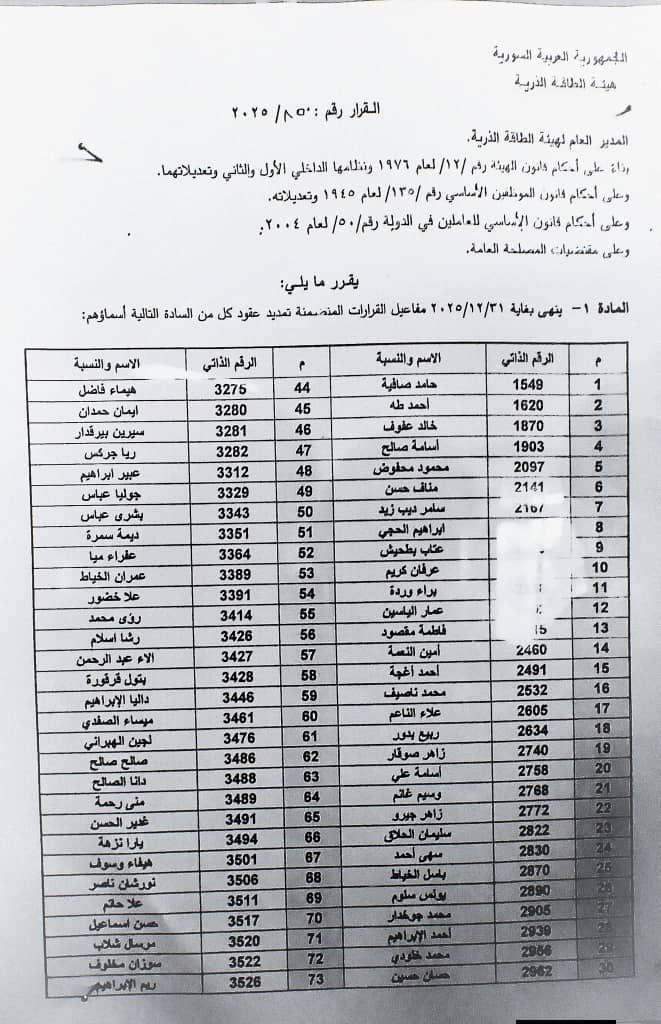
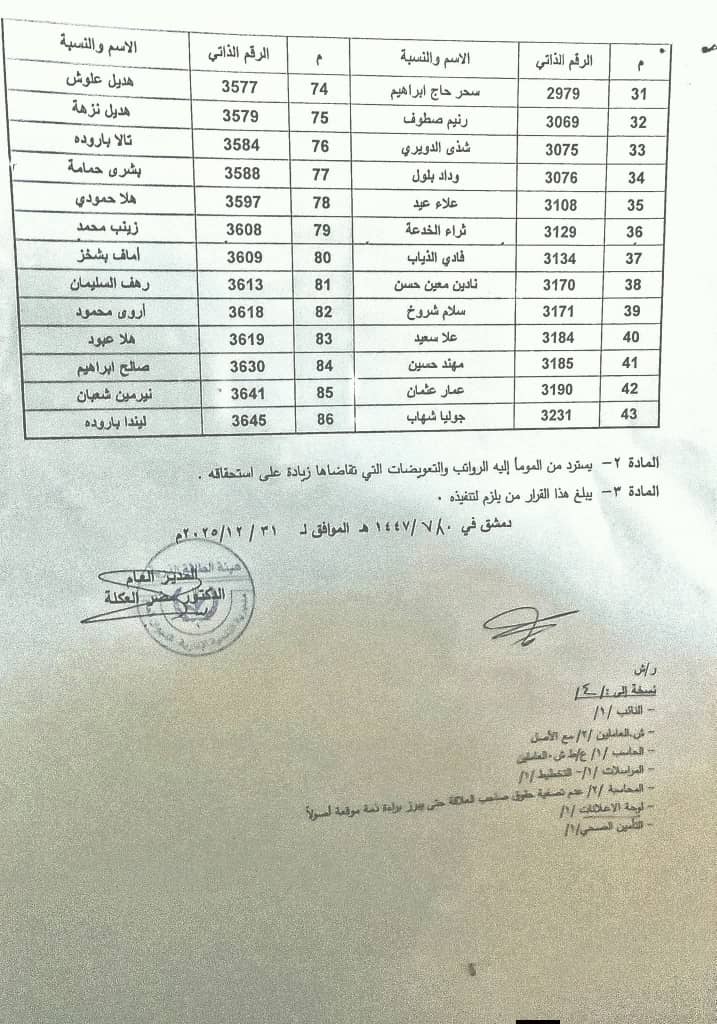
Dismissal of Employees at the Syrian Atomic Energy Commission – Damascus
Local sources in Damascus reported that a decision was issued to terminate the services of 86 male and female workers at the Syrian Atomic Energy Commission, a scientific institution established in 1976 that undertakes comprehensive responsibilities related to atomic energy affairs and its peaceful applications.
According to available information, the decision included a large number of employees who had spent many years working within the Commission. As of the time of preparing this report, the concerned authority had not announced the reasons for the decision or the criteria on which it was based, which raised widespread questions among employees, especially since the majority of those dismissed belong to the Alawite sect.
Mass Dismissal of Employees of Al-Wahda Newspaper – Damascus
It was also reported that a decision was issued stipulating the dismissal of 40 employees working at the Syrian newspaper Al-Wahda, a state-owned newspaper headquartered in Damascus. According to the information, the decision targeted all employees working under permanent contracts who are from the Alawite sect, without granting them any end-of-service compensation. It is noted that a number of those dismissed had exceeded 15 years of service, and had originally been appointed through official central competitions. According to the available data, the decision was not based on publicly declared legal justifications.
Forced Transfer of Female Teachers from Tartus to the Eastern Countryside of Homs
It was also reported on 3 January 2026 that more than 150 female teachers from Tartus Governorate, who had been appointed in 2021 to the Tal Kalakh Educational Complex, were transferred to schools located in the far eastern areas of Homs Governorate.
The concerned authorities granted a deadline not exceeding 72 hours to report to the new educational centers, which placed significant pressure on the teachers and prompted a number of them to consider submitting their resignations.
The data related to the three cases indicate that a broad segment of those affected belong to the Alawite sect, whether administrative employees, journalists, or educational staff, with the targeting of individuals with long experience and years of service.
These decisions come within a broader context of tensions and violations witnessed in the Syrian coastal regions during the past period. On 28 December 2025, peaceful demonstrations took place in several cities and areas, including Latakia, Jableh, Qardaha, Baniyas, and Tartus, in which civilians from the Alawite sect participated to protest what they described as escalating violations, including arrest, kidnapping, killing, and dismissal from jobs, in addition to the bombing that targeted the Ali ibn Abi Talib Mosque in the city of Homs, resulting in deaths and injuries, all of whom were from the same sect.
In a related context, the coastal region had witnessed, on 9 October 2025, a campaign of mass dismissals at the General Company for Spinning and Weaving in the cities of Latakia and Jableh, where 234 male and female workers were dismissed, most of them from the Alawite sect, followed by the dismissal of 49 additional workers the following day, raising the number of dismissed workers to 283 within just 48 hours.
Taken together, these incidents point to a recurring pattern of administrative measures targeting specific categories of employees and workers, amid escalating violence and sectarian discrimination in Syria, and the continued lack of transparency and absence of publicly declared legal standards in dismissal and transfer decisions.