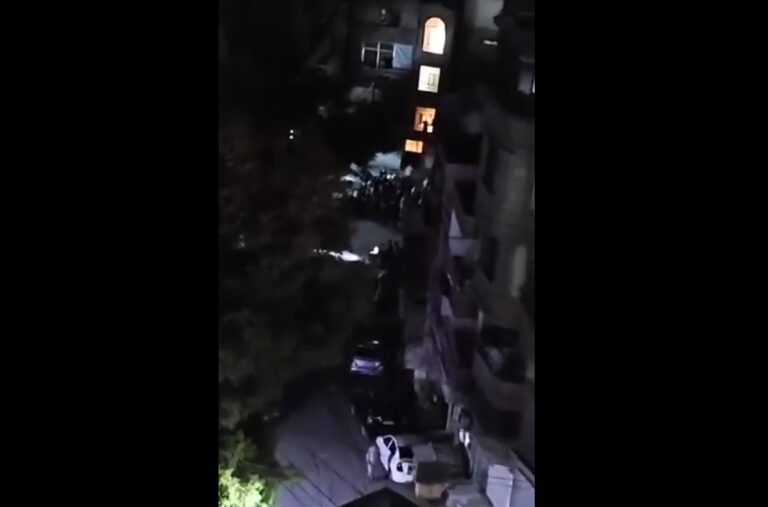
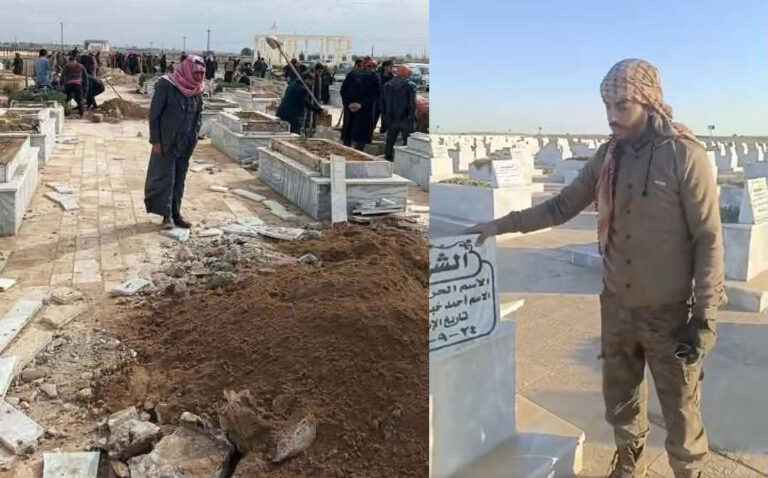
This human rights report documents a serious incident involving public and explicit incitement to killing and armed violence through the chanting of poetic verses attributed to Abu Mohammad al-Adnani, the former spokesperson of the so-called “Islamic State” (ISIS), an organization designated internationally as a terrorist group. The incident occurred during a military attack targeting the Syrian Democratic Forces (SDF) in the city of Raqqa on 21 January 2026, according to widely circulated visual materials.
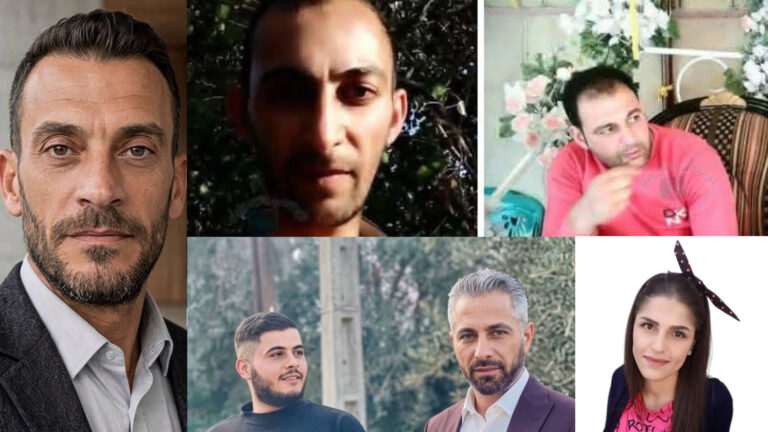
The individual appearing in the footage is Mohammad Hajja, known as (Abu Ubaida), a civilian from Latakia Governorate. Mohammad Hajja had previously appeared publicly in the aftermath of the Syrian coastal massacres against members of the Alawite community in March 2025. At that time, he presented himself as a spokesperson for “every honorable person who rejects killing” and addressed a direct message to “Abu Mohammad al-Jolani,” the head of the Syrian interim authority, Ahmad al-Sharaa, in which he condemned what he described as acts of genocide against the Alawite community, including the forcible removal of families from their homes and the killing of their members.
Following his public appearance and condemnation, credible reports emerged indicating that Mohammad Hajja had been abducted, without any official clarification regarding his place of detention or the authority responsible. What raises grave human rights concern, however, is his subsequent reappearance on 21 January 2026 during an armed attack on SDF forces in the city of Raqqa, where he was seen participating in hostilities while chanting verses attributed to Abu Mohammad al-Adnani that contain explicit incitement to killing and glorification of violence and so-called “combat martyrdom.”
Text of the Inciting Verses Attributed to al-Adnani
Killing is our habit and our mark,
Proof of our truthfulness; the coward lives long.
None of our leaders died upon his bed,
Nor did he lag behind in the fields of battle.
If one of our commanders falls, another rises,
Brave, noble, and fierce in his wake.
Killing is no disgrace for the free,
The Prophet wished for killing to be repeated.
Killing for the sake of God is an honor,
For martyrdom expiates sins.
Killing is better than a life of humiliation,
Ruled or commanded by the vile.
O Lord, strengthen us until
Our scattered remains are seen as an offering to You.
Chanting this text in the context of a military operation constitutes, under international standards:
Direct and public incitement to killing, an act criminalized under international human rights law.
Glorification of the ideology of a designated terrorist organization, constituting a violation of relevant United Nations Security Council resolutions on counterterrorism, in particular Resolutions 2170 (2014) and 2178 (2014).
This incident underscores the grave danger posed by the use of extremist religious discourse as a tool for inciting killing and violence. It calls upon international human rights mechanisms to document this incident within the record of serious violations, given the flagrant breach of principles relating to the protection of civilians, freedom of expression, and the prohibition of incitement to violence as enshrined in international law.