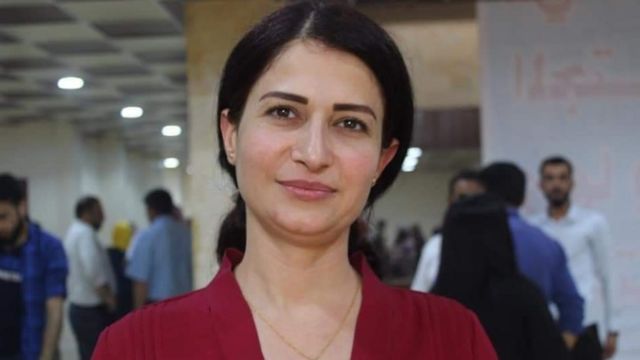
Al-Hasakah Governorate has witnessed a serious escalation marked by explicit death threats directed at the director of Al-Hol Camp, Jihan Hanan, by one of the camp’s residents. This incident raises grave concerns regarding the safety and security of humanitarian and administrative personnel operating within the camp and underscores the fragility of the security environment amid recent military developments in northern and eastern Syria.
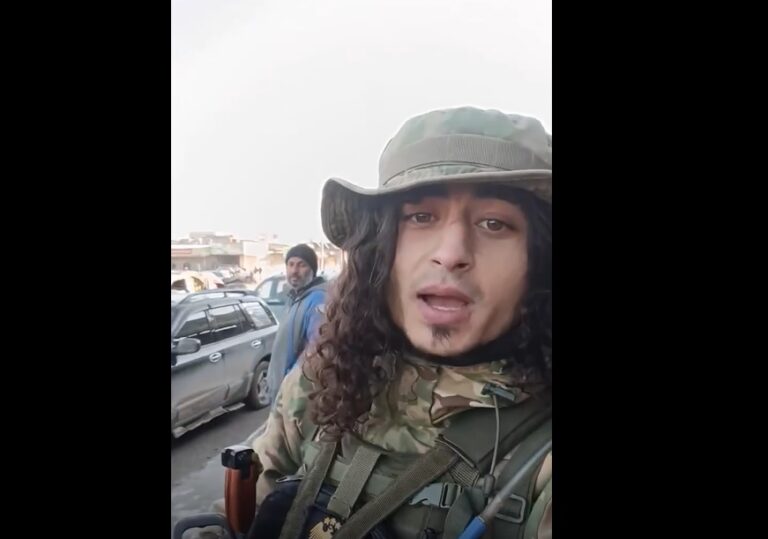
A circulated video recording shows an individual identifying himself as “Abu Suleiman al-Hasakawi,” a native of Al-Hasakah and a resident of Al-Hol Camp, present inside what appeared to be burned administrative offices. In the footage, he issues explicit death threats against the former camp director, Jihan Hanan, as well as several staff members whom he names: “Khorshid,” “Abu Dallo,” and “Abu Dilyar.”
The speaker alleges that his son, referred to as “Anwar,” was “paralyzed and killed” by the aforementioned employees inside the camp. He vows retaliation, stating that he knows their residential addresses within the city of Al-Hasakah and that he “will come to them soon and take revenge,” according to the content of the recording.
These public statements reflect a dangerous escalation in incitement to violence, posing tangible risks to the lives and physical integrity of former camp personnel. The threats constitute direct criminal intimidation and a clear violation of applicable law, necessitating urgent action by the competent authorities to ensure immediate protection, accountability, and the prevention of any potential acts of retaliation.
Al-Hol Camp is located in the southeastern countryside of Al-Hasakah and is among the largest camps in Syria. The camp has been associated with housing members of Islamic State (ISIS) and their families, in addition to Iraqi refugees and internally displaced Syrians. Available data indicate that the majority of camp residents are Iraqis who fled the governorates of Nineveh and Al-Anbar during military operations against ISIS in 2017.
The camp had been under the control of the Syrian Democratic Forces (SDF), while its administration and security were overseen by security institutions affiliated with the Autonomous Administration, commonly known as the Asayish.
On 9 September 2022, General Michael Erik Kurilla, former Commander of the United States Central Command, and Mazloum Abdi, Commander-in-Chief of the SDF, visited the camp, with Jihan Hanan appearing in the accompanying photographs of the visit.
The camp was also visited in September 2025 by Admiral Charles Brad Cooper, Commander of the United States Central Command, to discuss the camp’s conditions and enhance security and humanitarian cooperation.
In her capacity as Co-Chair of the camp administration, Jihan Hanan previously stated that efforts were ongoing to repatriate all residents to their countries and homes; however, the lack of response from concerned states has impeded these efforts. She emphasized that the camp issue does not concern the Autonomous Administration alone but falls within the responsibility of the international community.
According to her statements dated 19 April 2025, the camp’s population decreased from approximately 73,000 persons in 2019 to around 35,000 as a result of repatriation operations carried out in coordination with the Syrian and Iraqi governments.
On 12 February 2026, Agence France-Presse reported that most families of foreign ISIS members left the camp following the withdrawal of the Kurdish forces that had administered it in late January 2026 and its subsequent handover to Syrian security forces.
The agency cited a source within a humanitarian organization stating that the “foreigners’ section is now almost empty,” while another source indicated that only approximately 20 families remain in the “Muhajirat” section, which had previously housed women and children from Russia, the Caucasus region, and Central Asia. A significant number were reportedly smuggled to Idlib and other governorates, while a smaller number entered sectors designated for Syrians within the camp.
These developments occur within the context of a military operation conducted by forces affiliated with the “Syrian Interim Authority” against predominantly Kurdish areas. The operation began on 6 January 2026 targeting the Sheikh Maqsoud and Ashrafiyah neighborhoods in Aleppo city, before full control was established on 10 January 2026.
Subsequently, operations expanded to areas east of the Euphrates following alliances formed between certain Arab tribes and the Interim Authority forces, particularly in Raqqa and the northern countryside of Deir ez-Zor. The operations later extended to other Kurdish-majority areas, including Kobani, Al-Hasakah, and the countryside of Qamishli, amid reports of escalating violations.
The public threats directed at the director of Al-Hol Camp and several of its personnel constitute a serious indicator of rising rhetoric of violence and incitement within an already fragile security environment marked by rapid field developments. This incident underscores the urgent need to adopt immediate measures to ensure the protection of administrative and humanitarian staff and to initiate an independent investigation into the surrounding allegations, in a manner that guarantees accountability and prevents retaliatory acts that could result in grave human rights violations.