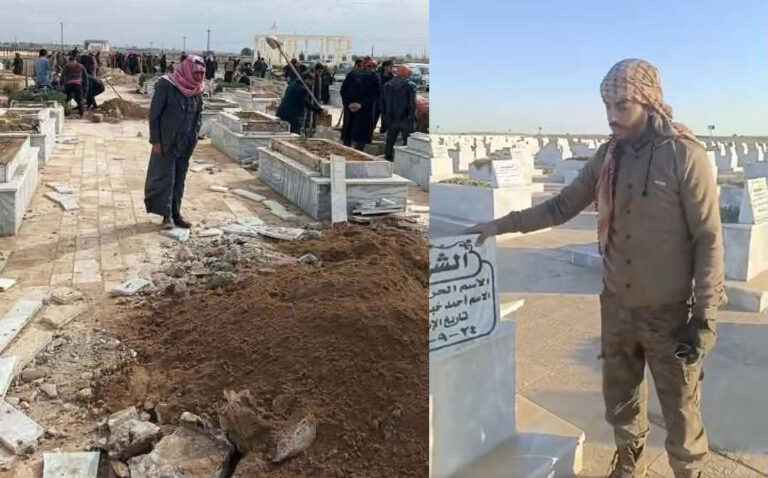
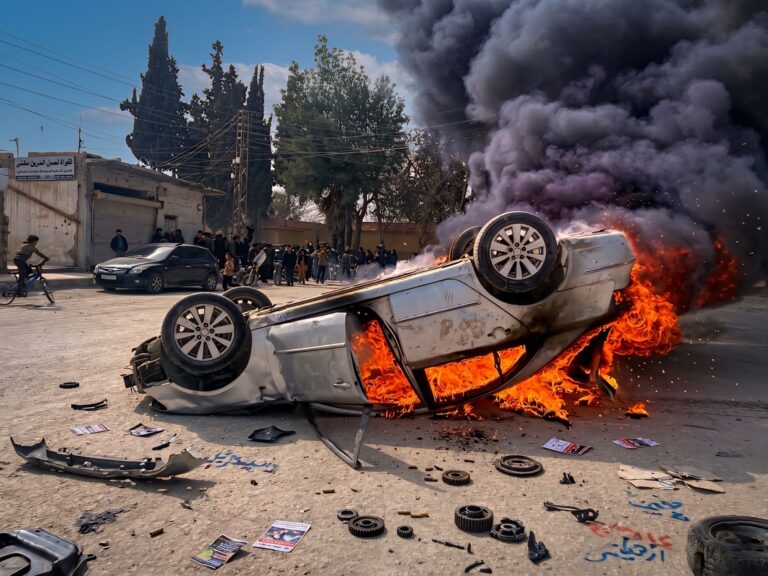
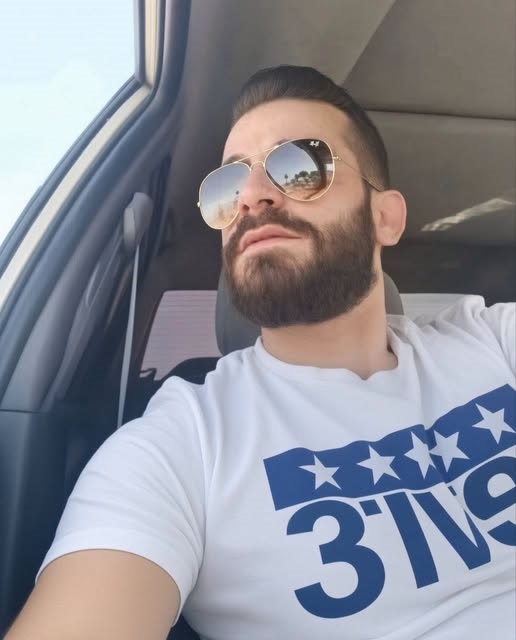
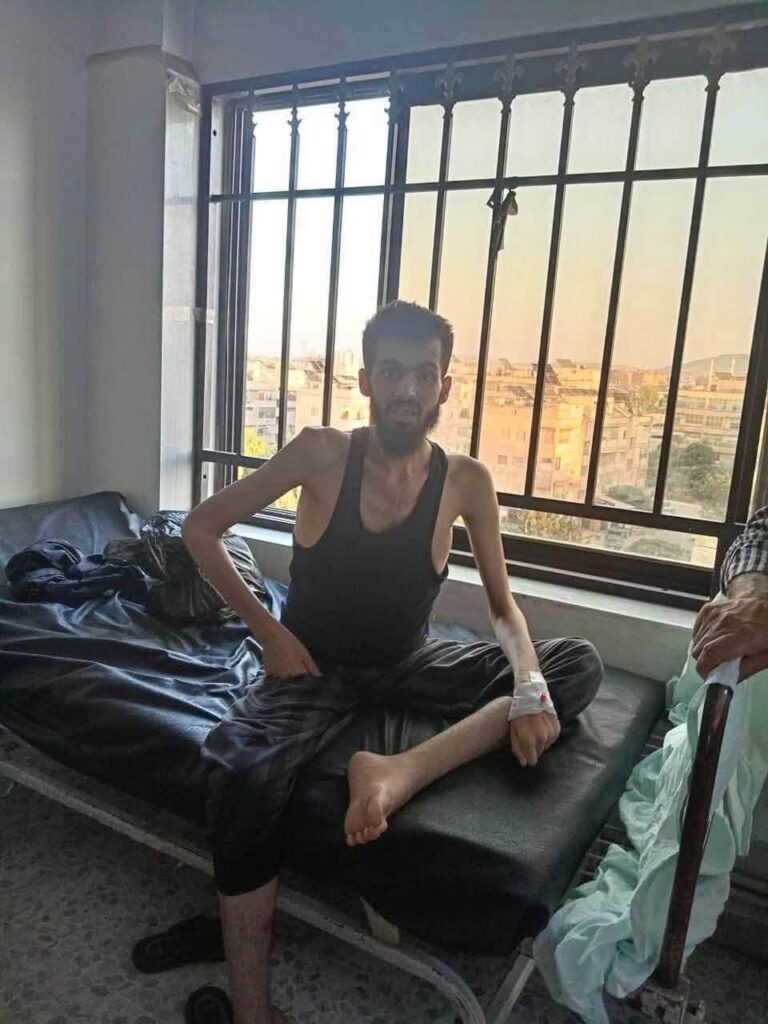
This report documents a horrific massacre committed against a Kurdish family of 12 civilians, including women and children, by armed individuals believed to be affiliated with forces loyal to the interim Syrian authorities, namely Hay’at Tahrir al-Sham (HTS). The incident occurred on 18 January 2026 at a temporary checkpoint near the village of Abu Khashab, north of Deir ez-Zor Governorate.
Visual evidence and audio recordings indicate the deliberate execution of members of the family on the basis of their ethnic identity (Kurdish), constituting a grave violation of international humanitarian law that may amount to a war crime and a crime against humanity.
The massacre took place one day after the launch of a large-scale offensive by the Syrian Arab Army and allied armed groups to seize control of the city of Raqqa from the Kurdish-led Syrian Democratic Forces (SDF). Amid escalating military operations and the withdrawal of the SDF from large parts of eastern Syria, the family attempted to flee Raqqa toward al-Hasakah (Rojava) in search of safety.
According to documented testimonies and evidence obtained by the Rudaw Media Network and human rights activists, the family left Raqqa in a small truck driven by Mohammed Ismail Saleh (50), accompanied by his wife Sara Shahin Saleh (49), their children, and other relatives.
At approximately 5:30 p.m., the family was stopped by an armed group at a road junction near the village of Abu Khashab. One of the gunmen asked, “Kurd or Arab?” When Mohammed Ismail Saleh replied that they were Kurds and had no political or military affiliation, the gunman—who appeared to be the group’s commander—issued a clear order:
“Kill all the adults.”
Victims
Members of the family were shot directly in the head, resulting in the deaths of:
Mohammed Ismail Saleh (50)
Sara Shahin Saleh (49)
Yousef Mohammed Saleh (20)
Layla Mohammed Saleh (17)
Afin Mohammed Saleh (10)
Mahmoud Ahmed Saleh (26) (husband of Shirin)
The remaining family members, including children, sustained varying degrees of injuries.
Audio Testimonies from the Scene of the Massacre
Audio recordings sent by Shirin Mohammed Saleh (25), who was shot in the back, constitute some of the most serious evidence of the crime. In one message, she stated:
“My father is dead, Yousef is dead, Mahmoud is dead, and my mother is dead… I’m calling them and no one is answering.”
In another message, she said:
“They shot me in the back… my children are in their hands, please come and take them.”
These recordings—11 in total—were provided by human rights activist Kamran Osman and document moments of execution, injury, and the forcible transfer of children.
Fate of the Wounded and the Children
According to testimonies:
The wounded were forcibly transported toward Deir ez-Zor and later abandoned on the road.
They were subsequently found and transferred to the Deir ez-Zor General Hospital.
Among the injured were:
Ghazal Mohammed Saleh (16)
Ibrahim Mohammed Saleh
Shirin’s children: Shadi (6), Ibrahim (4), and Lavand (2)
Legal Characterization
These acts constitute flagrant violations of:
Common Article 3 of the four Geneva Conventions, which prohibits the wilful killing of civilians.
Article 75 of Additional Protocol I, which guarantees protection for persons not taking part in hostilities.
Article 8 of the Rome Statute of the International Criminal Court, which criminalizes wilful killing and inhuman treatment as war crimes.
Furthermore, the targeting of the family on the basis of ethnic identity may amount to a crime against humanity if the systematic or widespread nature of such acts is established.
This massacre represents a dangerous pattern of continued extrajudicial executions and identity-based killings in Syria, amid near-total impunity.
Rights Monitor therefore calls for:
The opening of an independent international investigation.
The identification of individual criminal responsibility.
The protection of witnesses and survivors.
Ensuring that perpetrators do not evade accountability before international justice mechanisms.