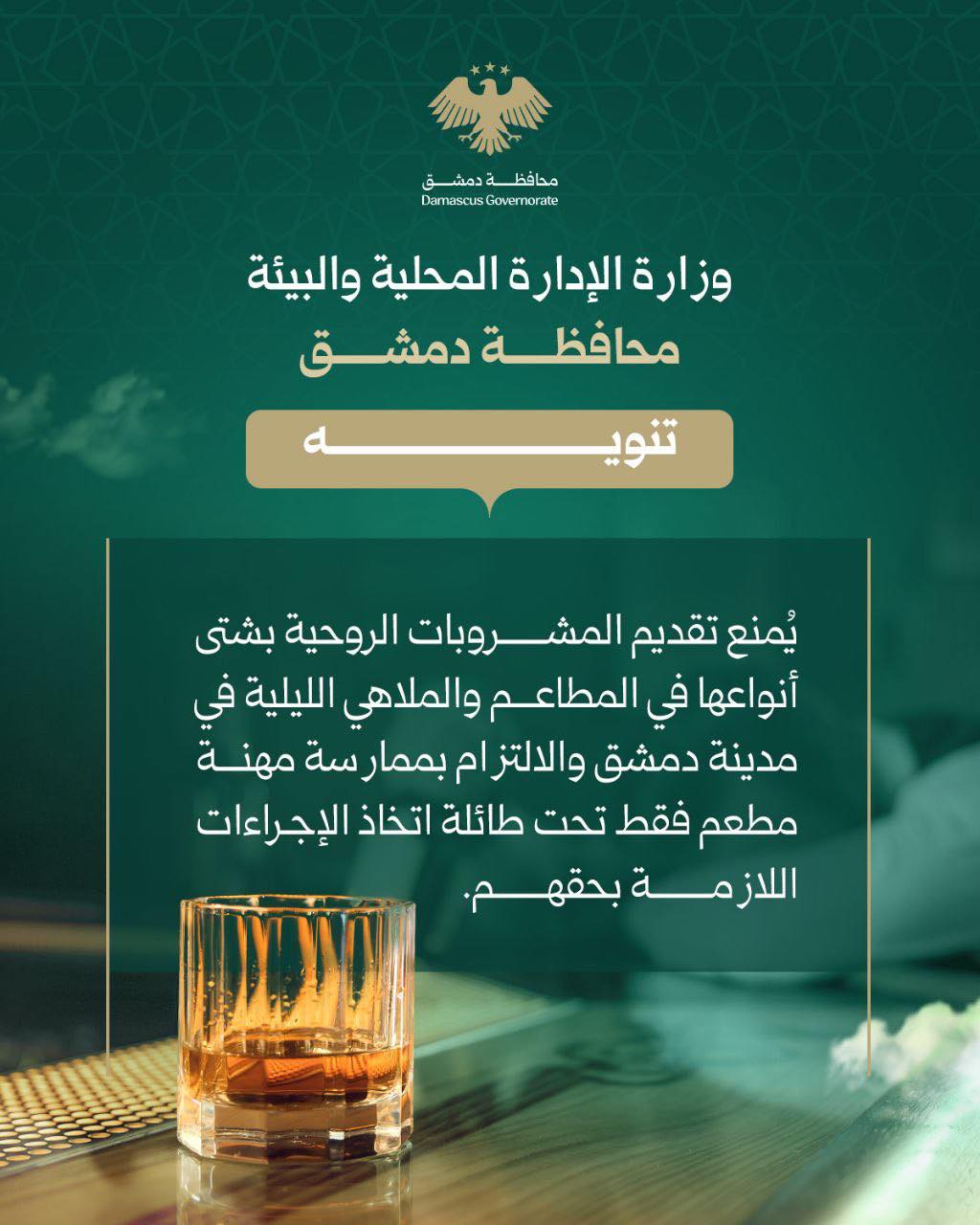
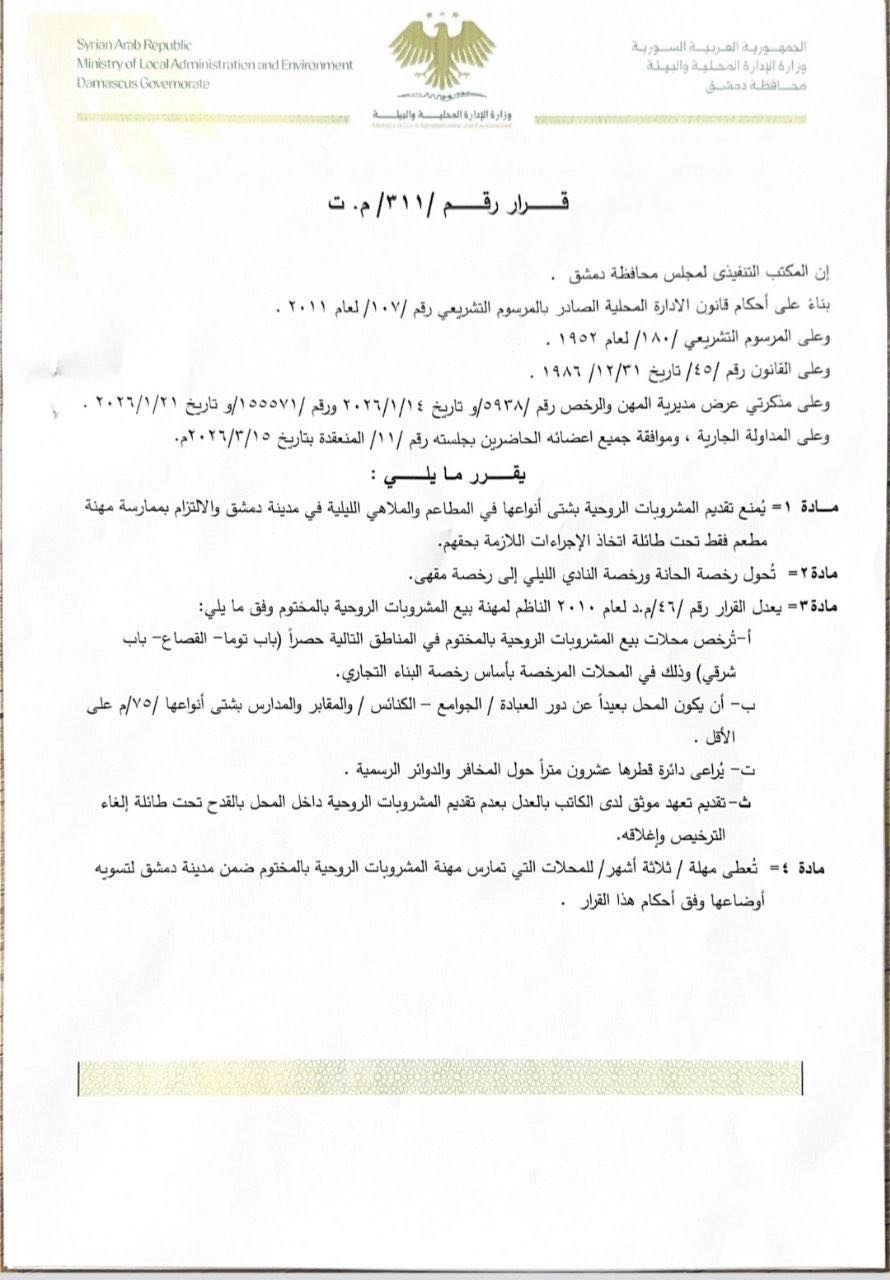
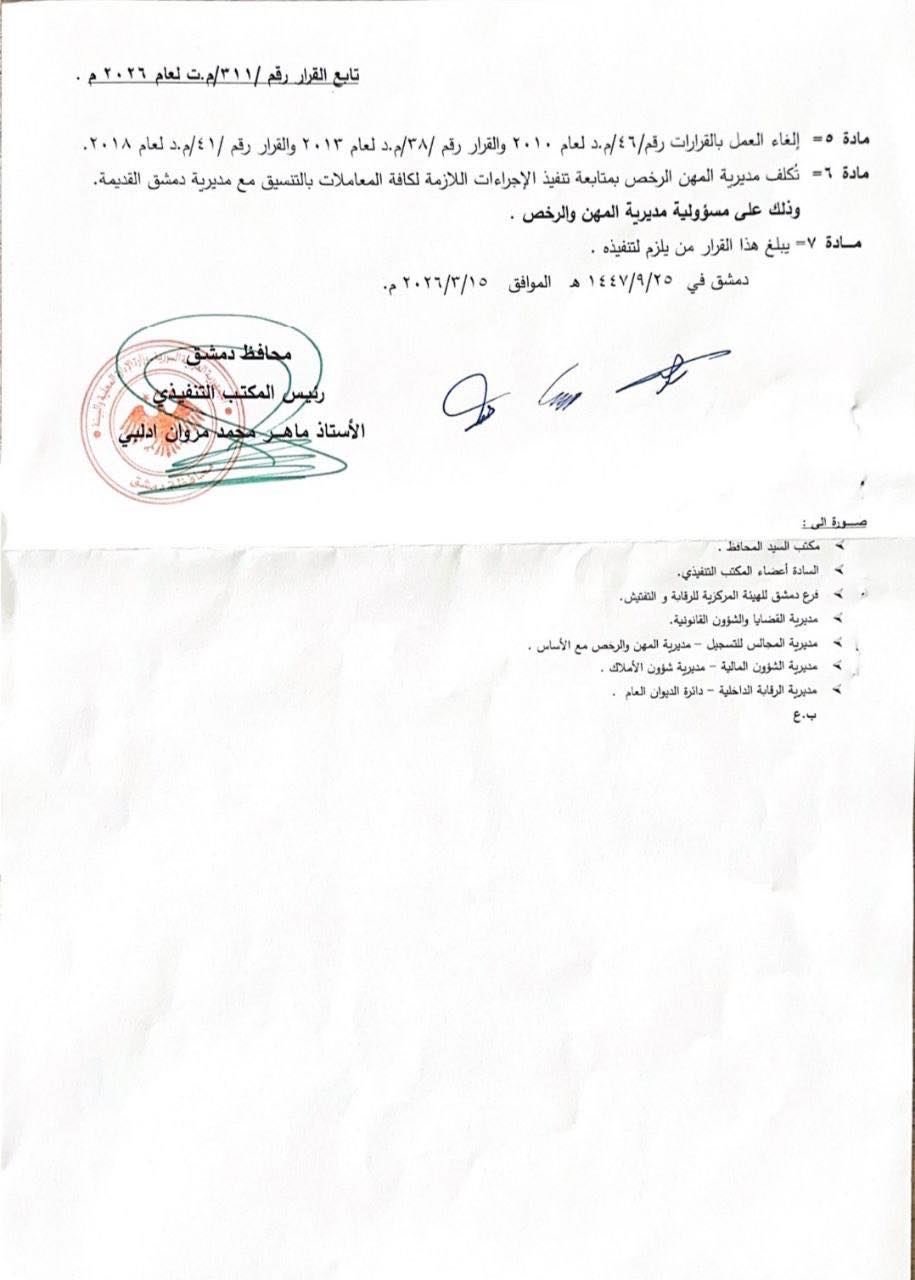
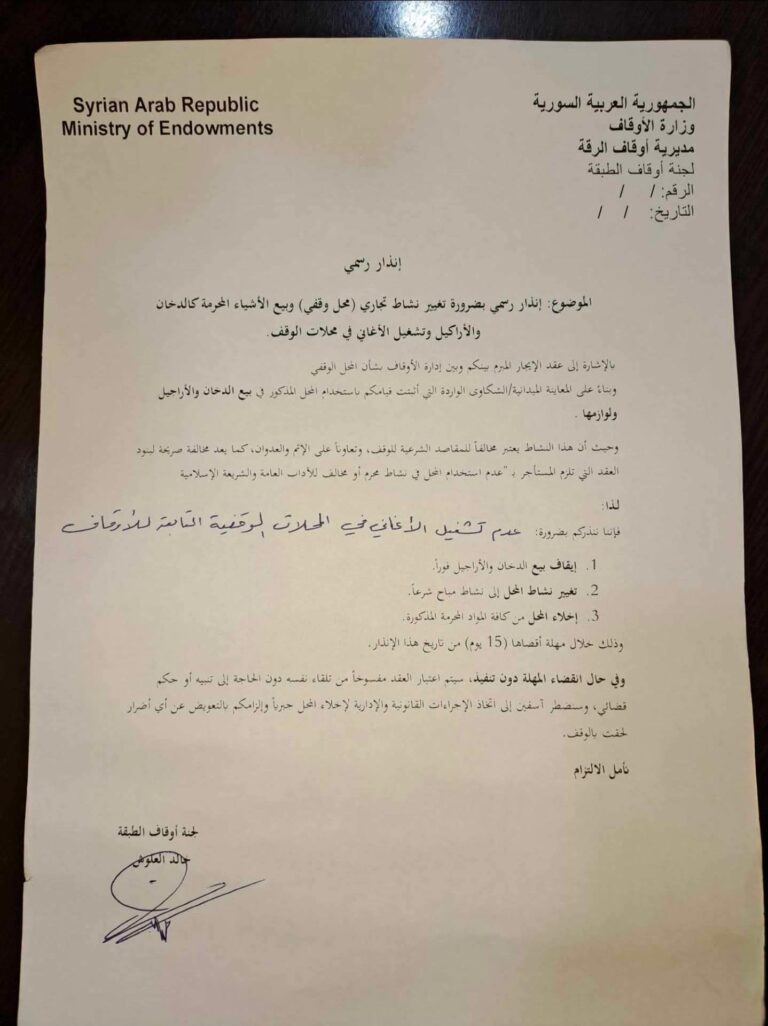
The Damascus Provincial Council issued an official decree on March 15, 2026, prohibiting the service of alcoholic beverages in restaurants and nightclubs within the city of Damascus. This move has sparked widespread debate and human rights concerns regarding the restriction of personal freedoms and lifestyles, amid official justifications based on “public morals” and requests from the “local community.”
According to the decree issued by the Executive Office of the Damascus Provincial Council, a package of regulatory measures aimed at limiting the circulation of alcohol within the city was enacted, most notably:
A total ban on serving alcoholic beverages in restaurants and nightclubs.
Restricting the sale of “sealed” alcoholic beverages to specific areas—namely Bab Touma, Al-Qassaa, and Bab Sharqi—within duly licensed shops.
Imposing spatial restrictions on points of sale, requiring a minimum distance of 75 meters between alcohol retail outlets and places of worship (mosques and churches), cemeteries, and schools.
Requirement of a 20-meter buffer zone around police stations and official government departments.
Mandating shop owners to provide a notarized undertaking (documented by a Notary Public) pledging not to serve alcohol for on-site consumption, under penalty of license revocation and permanent closure of the establishment.
Granting a three-month grace period for existing establishments to rectify their legal status in compliance with the new decree.
The decree, per its text, was issued in response to “a set of complaints” and “based on the request of the local community,” with the stated aim of “eliminating phenomena detrimental to public morals.” However, these phrases were not accompanied by precise clarifications regarding the nature of the complaints or the parties that submitted them, raising questions about the criteria for decision-making and the extent to which it actually represents the diverse segments of society.
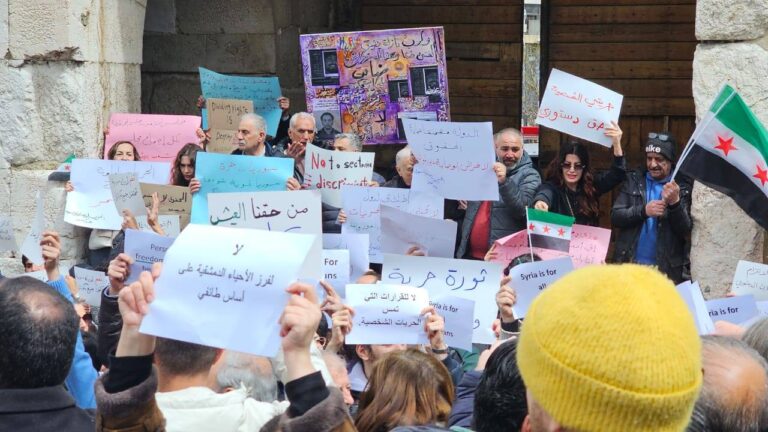
The decree raises significant concerns regarding the restriction of individual freedoms, including the freedom to choose one’s lifestyle and social activities, in addition to its potential impact on economic sectors such as hospitality, tourism, and entertainment. Furthermore, it prompts questions about the compatibility of these measures with the principle of non-discrimination, particularly in a religiously and culturally diverse city like Damascus.
The imposition of stringent geographical restrictions on points of sale, alongside new licensing requirements, may practically lead to a reduction in the number of authorized outlets. This is viewed as an indirect encroachment upon a pre-existing legal activity.
Reactions to the decree have varied; some commentators view it as a transition from “individualized restrictions” to “organized official policies,” while others believe it reflects an increasing trend toward imposing conservative social constraints.
In this context, critics expressed fears that these measures could gradually erode civic space and personal liberties. They noted that the high density of places of worship and public institutions in Damascus may make adherence to the mandated distances nearly impossible, effectively resulting in the closure of a vast number of shops.
The decree reflects a new regulatory direction in Damascus that may have direct repercussions on individual freedoms and economic activities. While authorities justify the move through social and moral considerations, human rights observers maintain that its effects require close monitoring and evaluation, particularly concerning the respect for fundamental rights and social diversity.