Rights Monitor Syria Expresses Concern Over Reports Regarding Educational Curriculum Modifications in Syria and Apprehensions of Impairing Religious, Cultural, and Historical Diversity
“Rights Monitor Syria” expresses its grave concern regarding circulating reports and criticisms concerning modifications affecting Syrian educational curricula, and the questions they raise regarding the nature of the changes introduced to historical, political, and pedagogical content and imagery, as well as the extent of their reflection on religious, cultural, and intellectual pluralism within Syrian society. The platform affirms that school is not merely a space for the indoctrination of information, but a fundamental institution for building awareness, promoting citizenship, and respecting human rights. Furthermore, any modification to curricula ought to be grounded in clear pedagogical, scientific, and human rights standards, far removed from exclusion, ideological indoctrination, or the imposition of a monolithic vision of societal identity.
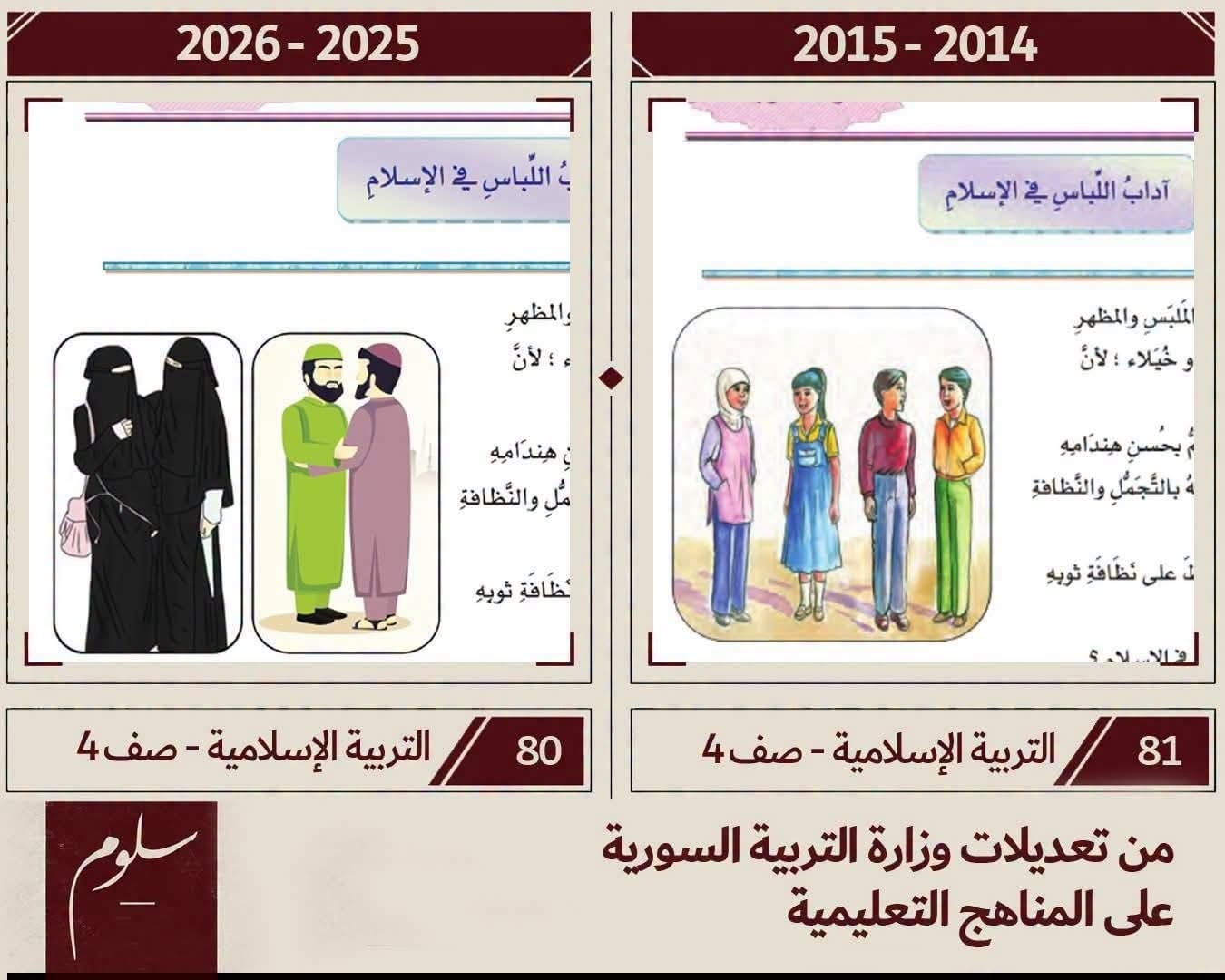
Circulating information indicates criticisms regarding the modification of images in textbooks, as well as the deletion or alteration of historical themes and figures—including those associated with political life, freedom, democracy, citizenship, and local governance—in addition to figures and milestones from Syrian history, and the issue of the Iskandaron (Alexandretta) Sanjak. Moreover, certain circulating images have raised apprehensions regarding an increased presence of religious manifestations in educational content in a manner that may reflect a trajectory toward establishing a single religious reference point.
In contrast, the Ministry of Education denied making new modifications beyond the scope of those it had previously announced, affirming that actions taken since the liberation were limited to a single modification announced in January 2025, and that the objective of curriculum development is to safeguard diversity, promote citizenship, and respect the other. The Ministry also announced the completion of the General National Curriculum Framework and the establishment of new standards for curriculum development, encompassing critical thinking, analysis, problem-solving, and the consolidation of national and human values alongside the culture of law.
While the platform takes note of this official clarification, it stresses that denying the implementation of additional modifications does not obviate the necessity of making available the information and documentation required to permit independent verification of the nature of the changes actually executed, comparing them with prior textbook editions, and clarifying the scientific and pedagogical foundations upon which competent authorities relied in their decisions.
First: Education is a Fundamental Right, Not a Tool for Ideological Imposition
“Rights Monitor Syria” affirms that the right to education is not limited to providing school seats and textbooks, but extends to ensuring educational content that respects the dignity of learners, develops their intellectual capacities, and enhances their ability to comprehend society and its history and to exercise critical thinking, without subjecting them to monolithic intellectual or religious direction.
In this context, Article 26 of the Universal Declaration of Human Rights stipulates that education shall be directed to the full development of the human personality and to the strengthening of respect for human rights and fundamental freedoms, and shall promote understanding, tolerance, and friendship among all religious groups. Article 13 of the International Covenant on Economic, Social and Cultural Rights similarly underscores the importance of directing education toward the full development of the human personality and the strengthening of respect for fundamental rights and freedoms.
Article 29 of the Convention on the Rights of the Child stipulates the necessity of directing the education of the child to the development of respect for their cultural identity, language, and values, and for civilizations different from their own, as well as preparing them for a responsible life in a free society, in the spirit of understanding, peace, tolerance, equality of sexes, and friendship among all peoples, ethnic, national, and religious groups. Article 30 of the Convention asserts the right of children belonging to ethnic, religious, or linguistic minorities to enjoy their own culture, to profess and practice their own religion, or to use their own language.
Accordingly, any review of curricula should be evaluated in light of these obligations, and must not result in the marginalization of components of Syrian society, the reduction of its history into a single narrative, or the presentation of religious and cultural differences as marginal or undesirable.
Second: Concerns Regarding Imbuing Curricula with a Monolithic Religious Character
The platform considers that the presence of religious education subjects within the educational system does not, in itself, constitute a human rights violation. The human rights issue pertains to the nature of the content, the degree of its respect for freedom of thought, conscience, and religion, the manner in which it represents the various components of society, and whether it is delivered within a pedagogical framework that respects diversity or transforms into a means for imposing a specific religious or social vision.
Modifying images and illustrations to conceal cultural or artistic manifestations, or deleting historical and intellectual content without announced scientific justifications—if proven to have occurred in a selective or discriminatory manner—would raise serious concerns regarding the integrity of the educational process and the extent of its respect for children’s right to access balanced knowledge, as well as their right to understand the religious and cultural pluralism that constitutes part of Syria’s history and society.
Furthermore, reducing national identity to a single religious affiliation or presenting the country’s history from a monolithic perspective may weaken the capacity of new generations to comprehend the diversity that characterizes Syrian society, and limit opportunities to consolidate equal citizenship and mutual respect among its members.
The platform stresses that respect for religion does not conflict with respect for freedom of thought and conscience, and that safeguarding national identity does not require the exclusion of other cultural and religious identities, but rather necessitates recognizing them and ensuring their equitable presence in the educational process.
Third: Protecting History, Freedom of Thought, and Citizenship
Allegations concerning the deletion of topics regarding historical figures, milestones, and intellectual texts raise questions that warrant serious and transparent verification.
Historical and pedagogical curricula are not merely a record of events; rather, they are a tool for understanding social and political transformations, gaining familiarity with societal experiences, and building the capacity to analyze facts and discuss diverse ideas. Curriculum review must not be converted into a tool for erasing historical facts or excluding figures or ideas simply because they differ from the political or intellectual orientations of the entity conducting the review.
The platform affirms that the deletion of any educational material does not automatically constitute a human rights violation, as certain reviews may be necessary to correct information or improve content. However, the legitimacy of such reviews requires the existence of announced standards, verifiable scientific justifications, and an independent review ensuring that the development process is not utilized to reproduce exclusion or substitute one ideological narrative with another.
Fourth: Responsibility, Transparency, and Accountability
“Rights Monitor Syria” asserts that the Ministry of Education and the bodies responsible for preparing and reviewing curricula bear the responsibility to ensure the alignment of educational content with pedagogical and human rights standards, provide the necessary information to verify decisions taken, and make effective mechanisms available for objection and review.
In the event that the introduction of discriminatory or exclusionary modifications, the arbitrary deletion of historical and intellectual content, or the utilization of curricula to impose a religious or ideological orientation on children is established, administrative, political, and legal responsibility—according to the nature of the acts, evidence, and applicable legal rules—should be clearly determined, and no official should be exempted from accountability merely because decisions were issued by an official authority.
Conversely, the platform rejects leveling preemptive accusations against specific individuals or entities without sufficient evidence, and stresses the necessity of distinguishing between established facts and allegations that still require verification, thereby ensuring the integrity of human rights documentation and protecting the right of all parties to present information and respond to it.
Fifth: Demands of the “Rights Monitor Syria” Platform
Based on the foregoing, the platform demands the following:
The Ministry of Education: Publish the official versions of the curricula before and after the modifications, accompanied by a detailed statement of the changes made to texts, images, and subjects, specifying the date, reasons, and adopted standards for each modification.
Conduct an Independent and Transparent Review: Form a specialized committee comprising experts in education, history, human rights, and law, alongside representatives from Syria’s various cultural, religious, and linguistic components, to evaluate the curricula and ensure they are free from discrimination, exclusion, and ideological indoctrination.
Guarantee Religious and Cultural Pluralism: Review educational content to ensure a balanced representation of Syria’s history and its components, respecting different religions, beliefs, and cultures without discriminatory preference or derogation of any component.
Protect Civic Education and Critical Thinking: Ensure the inclusion of human rights, citizenship, freedom, civic participation, the rule of law, and critical thinking topics in curricula, in accordance with scientific and pedagogical foundations appropriate for students’ age groups.
Safeguard Historical Accuracy: Subject any deletion or modification related to historical and intellectual figures and events to documented scientific review, and publish the rationale supporting such decisions to prevent the manipulation or utilization of the historical record for political or ideological purposes.
Engage Society: Open a public dialogue involving teachers, researchers, parents, students (where age-appropriate), civil society organizations, and representatives of Syrian components prior to adopting new curricula or executing substantial modifications thereto.
Establish an Independent Complaints Mechanism: Enable teachers, parents, and students to report discriminatory or inaccurate content, and guarantee that complaints are examined under clear and transparent procedures, with the results of reviews and recommendations made public.
Accountability Upon Proven Infringements: Determine administrative and institutional responsibilities for any modifications proven to involve discrimination, exclusion, or violation of applicable legal standards, take appropriate corrective measures, and ensure non-recurrence of infringements.
Role of Competent International Bodies: Call upon UN entities concerned with children’s rights and the right to education, as well as the United Nations Educational, Scientific and Cultural Organization (UNESCO), to follow up on the curriculum development file in Syria and provide the necessary technical support to advance inclusive, pluralistic education aligned with human rights.
Conclusion
“Rights Monitor Syria” affirms that the future of education in Syria must be founded upon knowledge, freedom, responsibility, and respect for pluralism, rather than exclusion or the imposition of a monolithic identity on new generations. Educational curricula ought to serve as a space for learning about the country’s history in its various aspects, understanding its cultural and religious diversity, and fostering the capacity for thinking, discussion, and respect for the other.
While taking note of the Ministry of Education’s clarifications regarding the nature of the modifications and curriculum development plans, the platform calls for a transition from general statements to practical transparency through making documents and curricula accessible for independent comparison, clarifying adopted standards, and involving society in the review process.
It further stresses that any responsibility for discrimination, exclusion, or infringement upon children’s rights must be determined based on credible evidence and an independent professional investigation, accompanied by the implementation of necessary corrective measures upon the establishment of violations.
Building an inclusive national education system cannot be achieved by imposing a single vision on society, but rather by guaranteeing the right of every child to an education that respects their dignity and identity, familiarizes them with their country’s history and diversity, and prepares them to participate in a society based on equality, the rule of law, and respect for human rights.