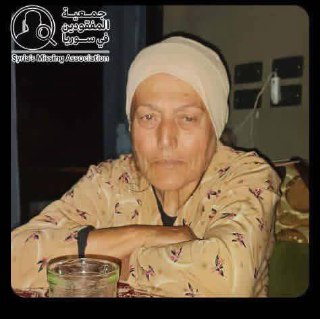
The security forces affiliated with the interim authority known as “Hay’at Tahrir al-Sham” have continued to detain Mrs. Nadia Ali al-Kaadi, aged 70, since 12 November 2025, in Tartous Prison – Trust Section, without bringing any legal charge against her and without the issuance of any official information regarding her legal status or her health condition inside the place of detention.
Mrs. Nadia Ali al-Kaadi is from the village of Ain Shaqaq in the rural area of Jableh in Latakia Governorate, and she belongs to the Alawite sect. According to local sources, the sole stated reason for her detention is that one of her sons is wanted by the authorities, which indicates that her detention is being used as a means of pressure on her family, within what is known as the taking of relatives as hostages.
Since the moment of her arrest, Mrs. Nadia has been living under unknown conditions of detention, amid a complete blackout and the prevention of her family and lawyers from communicating with her or checking on her safety. To date, no confirmed information is available as to whether she is still alive, which raises serious concerns about her fate.
These concerns are heightened in light of her health condition, as Mrs. Nadia suffers from diabetes and high blood pressure and requires daily treatment and special medical care—requirements whose availability to her inside the prison is unknown.
This incident points to a pattern of grave human rights violations, including arbitrary detention and collective punishment, and contravenes the provisions of Syrian law and international law, particularly with regard to the right to liberty and personal security and the prohibition of detaining individuals because of acts attributed to their relatives.
This incident occurs within a broader context marked by an increase in incidents of abduction, detention, and violations against members of the Alawite sect in various parts of Syria, amid the absence of accountability and weak legal safeguards, which further exacerbates the vulnerability of women and the elderly belonging to religious and sectarian minorities.